
On July 30, the National Bank raised the discount rate to 15.5%. The rate had remained at 15% since January 30, 2026—exactly half a year.
Reasons for the Decision
NBU Governor Andriy Pyshnyy explained the decision as necessary to halt the acceleration of inflation and maintain financial stability. According to him, fundamental price pressures in Ukraine are steadily intensifying—primarily due to rising business costs for logistics, labor, and energy resources.
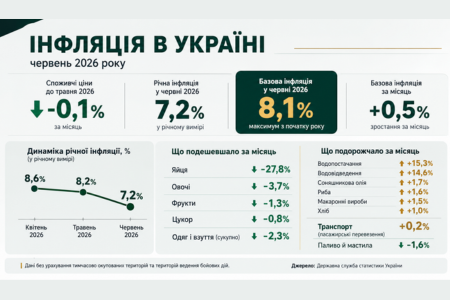
Specifically, in June 2026, annual inflation slowed for the first time since the beginning of the year—to 7.2% from 8.2% in May. However, in July, consumer price growth resumed, while core inflation continued to rise.
Andriy Dubas, President of the Association of Ukrainian Banks, noted that three factors are driving inflationary pressure:
“The war in the Middle East has driven up oil and fuel prices. Labor costs are rising in the labor market due to a shortage of workers—this is being recorded by the State Statistics Service and recruitment agencies. Attacks on infrastructure and the energy sector are increasing the need to import energy equipment, which also affects inflation.”
This is the second rate hike cycle in the past year and a half. In March 2025, the NBU had already raised the rate to 15.5%—it remained at that level for nearly a year, until January 30, 2026, when the rate was lowered to 15% for the first time in 10 months.
Inflation Forecast and Real Interest Rate
Along with its interest rate decision, the NBU published an updated macroeconomic forecast for 2026–2028. The inflation forecast has been revised downward: for 2026, from 9.4% to 10%, and for 2027, from 6.5% to 6.9%. Inflation will begin to decline in 2027 and reach the 5% target by the end of 2028. A return to a cycle of monetary easing is possible in the second quarter of 2027.
Based on these figures, the real interest rate (the nominal rate of 15.5% minus the expected inflation rate of 10% at the end of 2026) is approximately +5.5 percentage points.
Exchange Rate and Reserves
In addition to the discount rate, the NBU curbs inflation through exchange rate stability, which it ensures with its gold and foreign exchange reserves. The NBU has significantly revised its reserve forecast upward: $69.7 billion by the end of 2026 (previously $64.8 billion) and $73.7 billion by the end of 2027 (previously $66.5 billion).
The NBU attributes this growth to a shift in funding sources: part of the defense component of the Ukraine Support Loan program is directed toward localizing weapons production in Ukraine, and the corresponding foreign exchange proceeds are added to international reserves. According to Andriy Pyshnyy, this represents a fundamental paradigm shift in both economic growth and the functioning of the country’s foreign exchange market—at the same time, it will require the NBU to increase its interventions to meet the growing demand for foreign currency.
According to Andriy Dubas, this level of reserves provides the NBU with a practical tool for curbing panic in the foreign exchange market:
“With such gold and foreign exchange reserves, the National Bank can feel very confident and quell virtually any panic through interventions. If the exchange rate rises, they actively enter the market and meet demand—thus preventing the exchange rate from rising.”
According to the Association’s president, the National Bank will not allow a sharp devaluation, as the exchange rate has a direct impact on inflation through the import component. Therefore, the hryvnia-to-dollar exchange rate is expected to remain within the range of 44.9–45.1.