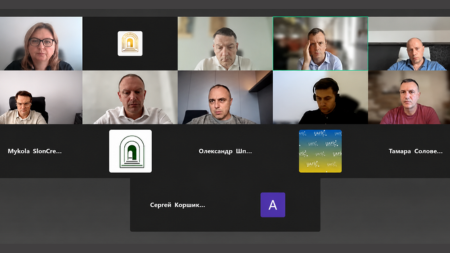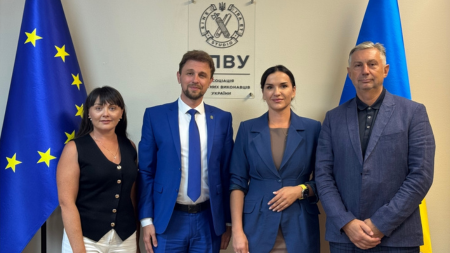

On April 14, 2026, a meeting of the Committee on Financial, Banking, and Investment Activities of the Confederation of Builders of Ukraine was held, during which the current state and prospects of housing construction financing were discussed.
The discussion was attended by representatives of the banking sector, development companies, relevant institutions, as well as representatives of the Association of Ukrainian Banks.
The Association of Ukrainian Banks (AUB) was represented by AUB President Andriy Dubas and Chair of the AUB Committee on Compliance and Financial Monitoring Hanna Gorbenko.
The meeting was moderated by AUB Vice President and Chairman of the Board of Globus Bank Serhiy Mamedov.
Key Discussion Points
Participants focused primarily on the reasons for the limited availability of credit for new residential construction and possible ways to boost it.
As Anna Gorbenko noted, the key barrier lies not in a lack of resources within the banking system, but in differing perceptions of business models:
“The main problem arises not from banks’ ability to work with the construction sector, but from differing perceptions of business models. What is clear and logical to a developer may appear to a bank as a complex, fragmented structure with elevated risks.”
In this context, project transparency is of decisive importance—a clear financial model, an understandable structure of agreements, and compliance with financial monitoring requirements.
Project preparation quality as a financing factor
Continuing the topic, Serhii Mamedov emphasized that developers’ access to financing increasingly depends on the quality of project preparation:
“The quality of project preparation is becoming a key factor in developers’ access to financing: a transparent structure, a clear financial model, and compliance with the requirements of banks and financial monitoring.”
According to him, it is precisely these factors that determine the speed of decision-making and the ability to scale construction projects.
Market Trends and the Role of Mortgages
Special attention was paid during the meeting to the state of mortgage lending. Olena Dmitrieva, First Deputy Chair of the Management Board of Globus Bank, presented an assessment of the situation.
“The volume of new construction remains below pre-war levels, which poses a risk of a slowdown in the completion of projects in the coming years. At the same time, lending is gradually recovering and is already showing positive momentum, although its share in financing new construction remains limited for now.”
According to her, the market is gradually adapting to the new conditions, but further growth will depend on the revitalization of bank lending, the expansion of support tools, and the stimulation of new construction, particularly in the regions.
During the discussion, it was also noted that the state program “eOselya” plays a key role in supporting the market, accounting for up to 99% of loans in the primary market.
At the same time, the penetration rate of lending in primary construction remains low—about 0.9% of new construction volumes.
Status of New Construction
In assessing the overall market dynamics, participants noted the pace of new project launches. According to their estimates, in 2023–2025, the number of projects under construction will account for approximately 70% of the volume of housing units commissioned. This creates a risk of a further reduction in market supply in the medium term.
Proposals following the meeting
Based on the discussion, participants emphasized the need to expand support tools for the industry.
In particular, it was proposed to approach the Government and relevant institutions with a proposal to include residential construction in the list of priority areas of the state program “Affordable Loans 5–7–9%.”
The banking system has sufficient resources to finance construction, but the intensification of lending directly depends on the quality of project preparation. Transparency, structure, and compliance of projects with the banking sector’s requirements remain key conditions.