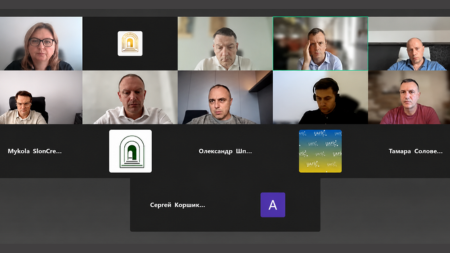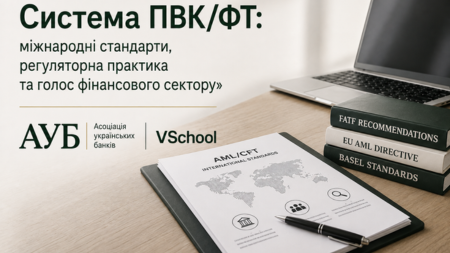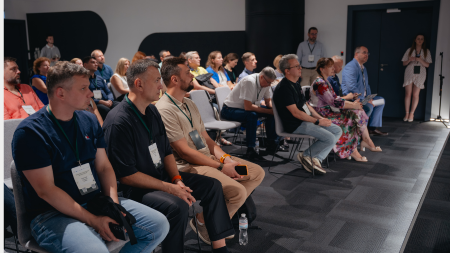

On April 16, 2026, the Association of Ukrainian Banks, in collaboration with VSchool, held an online webinar titled “Current Trends in Financial Monitoring: European and National Experience, Challenges Facing the Financial System.” The speakers at the event were Alla Levkovych—Chief Compliance Officer and Head of the Compliance Control Department at JSC “UKRSIBBANK”— and Yevheniia Balyasna, Head of the Sanctions Policy and Export Control Division with international experience in financial monitoring and sanctions compliance. Over 250 representatives from the banking and non-banking sectors joined the webinar.
The speakers presented key changes in the AML/CFT field in the EU. They focused on the new legislative package, which provides for the creation of the European Anti-
Money Laundering Agency (AMLA), the implementation of AMLR and AMLD6, and the update of the WTR. They also emphasized that the AMLA will supervise high-risk institutions, coordinate the work of financial intelligence units (FIUs), and establish uniform standards for financial monitoring.
They focused in detail on the impact of artificial intelligence on the AML/CFT sector. They noted that AI enhances the effectiveness of financial monitoring through big data analysis, improved risk assessment, and process automation. At the same time, they highlighted the growing risks associated with fraud, the use of deepfakes, and synthetic identities.
The webinar also discussed the rise of fraud in the EU. Key factors include the development of digital technologies and artificial intelligence, geopolitical instability, and the proliferation of digital payment instruments. At the same time, financial institutions are actively investing in risk mitigation technologies, although their capabilities remain constrained by regulatory and ethical requirements.
The discussion also focused specifically on sanctions policy. Examples of changes to sanctions regimes were examined, demonstrating their dynamic nature, as well as the role of the EU Sanctions Helpdesk as a business support tool.
The webinar also covered the provisions of the EU Anti-Corruption Directive, aimed at harmonizing approaches to criminal liability and strengthening cooperation among EU authorities.
A significant portion of the discussion was devoted to the challenges facing Ukraine. In particular, the discussion focused on countering the use of “drop accounts” and shell companies for the transit of funds and the concealment of their origin.
The speakers emphasized that such schemes affect various categories of clients—from individuals to sole proprietors and legal entities. At the same time, traditional control methods are not sufficiently effective, creating a need for new approaches. This involves, in particular, creating client risk profiles using machine learning tools that take into account behavioral and technical indicators.
They also emphasized the importance of imposing restrictions on certain types of transactions as early as the client onboarding stage.
In conclusion, participants engaged in an open discussion and exchanged practical experiences.
The webinar confirmed the importance of regular professional dialogue among financial sector participants. Such an exchange of experience contributes to a more effective response to current AML/CFT risks and strengthens the resilience of Ukraine’s financial system.