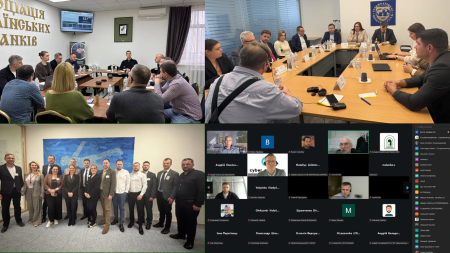

On April 3, 2026, the Arbitration Court of the Association of Ukrainian Banks held a professional webinar dedicated to the implementation of international arbitration standards in Ukraine.
Webinar participants—lawyers, judges, and representatives of the business community—discussed how the best global practices in the field of arbitration can be applied in domestic legal practice.
The keynote speaker was Olena Perepelynska, an international arbitrator, attorney, Head of the Arbitration Practice at IMPACTA Law Firm, and Co-Chair of the Eastern European Regional Group of the Arbitration Committee of the International Bar Association (IBA).
Uniform Standards — Diverse Traditions
In her presentation, Olena Perepelynska outlined the current landscape of international arbitration. According to her, UNCITRAL documents have formed a common legal framework that helps various states harmonize their own legislation. At the same time, leading arbitration jurisdictions—the United Kingdom, France, Switzerland, and Sweden—maintain unique national regulatory models that combine local traditions with international standards.
IBA “Soft Law” as a Universal Guide
A separate section of the report was devoted to the “soft law” instruments of the International Bar Association (IBA), which have effectively become the industry standard in arbitration practice. These include the IBA Rules on Evidence (updated in 2020), recommendations on resolving conflicts of interest using a “traffic light” system, and guidelines on party representation, including witness preparation. Notably, these documents are increasingly being taken into account not only by arbitral tribunals but also by state courts.
Experience of European Courts
The speaker presented current judicial practice from several countries. In particular, decisions by courts in Sweden, the Lithuanian Court of Appeals (2026), and the Austrian Supreme Court (2025) were examined. The examples cited demonstrate a consistent trend: European national courts are increasingly aligning with international arbitration standards and enhancing their interaction with arbitration as a dispute resolution tool.
Challenges and Prospects for Ukraine
In the context of Ukrainian realities, webinar participants referred to the USAID study “Improving Commercial Dispute Resolution Mechanisms in Ukraine: An Assessment of the Basic Institutional and Legal Environment.” The document highlights the need for further development of institutional capacity and improvement of the legal environment in the field of commercial disputes.
Conclusions: Arbitration as a Factor in Investment Attractiveness
Following the discussion, participants unanimously agreed that the adoption of best global arbitration practices—in particular those developed by the IBA and UNCITRAL—is a necessary prerequisite for establishing a modern, effective, and predictable dispute resolution system in Ukraine. And this directly impacts the country’s investment attractiveness and its integration into the international legal landscape.