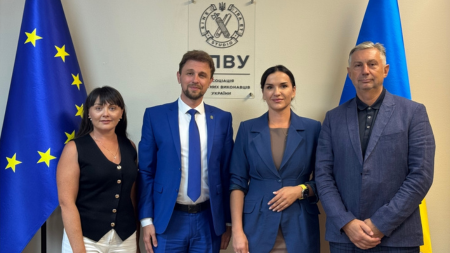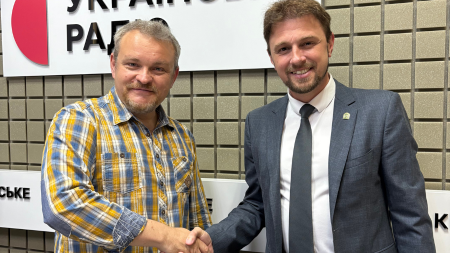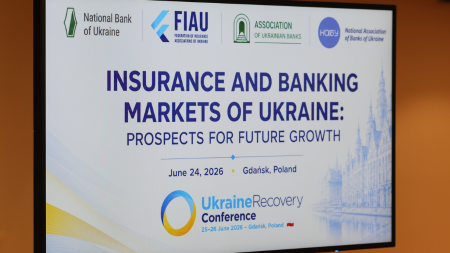

Sanya Petrinich Turkovich, Executive Director of the Prudential Regulation, Methodology, and Direct Supervision Sector at the Croatian National Bank, spoke at the roundtable discussion titled “Harmonization of Ukraine’s Financial Sector Legislation with EU Directives and Regulations: Priorities and Challenges.”
The event was organized by the Association of Ukrainian Banks and the National Bank of Ukraine with the support of the STEP IN 2 EU program, which is co-financed by the governments of Germany and Norway, as well as the European Union under the EU4Business initiative, and implemented by the German federal company Deutsche Gesellschaft für Internationale Zusammenarbeit (GIZ) GmbH.
During her speech, Sanja Petrinic Turkovic shared Croatia’s experience with European integration in the financial sector and emphasized that Ukraine is already well-prepared to adapt its banking legislation to EU standards.
“We also went through a war. We also rebuilt the state after the war and restored the banking system after the war. Therefore, much of what Ukraine is going through today is very familiar to us,” noted Sanja Petrinic Turkovic.
According to her, Croatia’s path to the EU was long and involved a large number of criteria, benchmarks, negotiations, and adaptation phases. One of the key factors for success was coordination between the regulator, the banking sector, industry associations, and the expert community.
“It was precisely this coordination that made us stronger in the early years of integration. That is why I always recommend maintaining a strong team and fostering constant communication among all participants in the process,” she emphasized.
Sanya Petrinich Turkovich noted that banking sector regulation in the EU is complex and constantly evolving. Specifically, this includes the CRD directives and the CRR, BRRD, and DGSD regulations, as well as areas related to securitization, ESG, and AML.
She also emphasized the importance of understanding the difference between EU directives and regulations. Directives allow countries a certain degree of flexibility to adapt provisions to the specifics of their national markets. Regulations, on the other hand, are applied directly—and upon joining the EU, banks must comply with them fully.
“When it comes to regulations, the situation is completely different. Regulations are applied directly. And upon joining the EU, banks must comply with them fully and simultaneously, without any additional adaptation mechanisms,” she said.
The speaker also emphasized the importance of a candidate country’s negotiating position. According to her, European integration is not only about implementing legislation but also a process of negotiating with the European Commission on issues critical to the national financial sector.
“The negotiating position is extremely important. We need to clearly identify which issues are critical for the financial sector and where we need to stand our ground,” noted Sanya Petrinich Turkovich.
She also noted that harmonizing legislation with EU standards is important not only for future membership but also for obtaining equivalence status. Such status could allow banks, government agencies, or public sector institutions from third countries to operate under conditions similar to those in Europe even before full accession to the EU.
Sanya Petrinich Turkovich paid particular attention to issues of credit risk, corporate governance, crisis management, deposit guarantee schemes, and AML. According to her, it is important to take the principle of proportionality into account in these areas, especially for small banking institutions.
At the same time, she gave a positive assessment of Ukraine’s level of preparedness.